
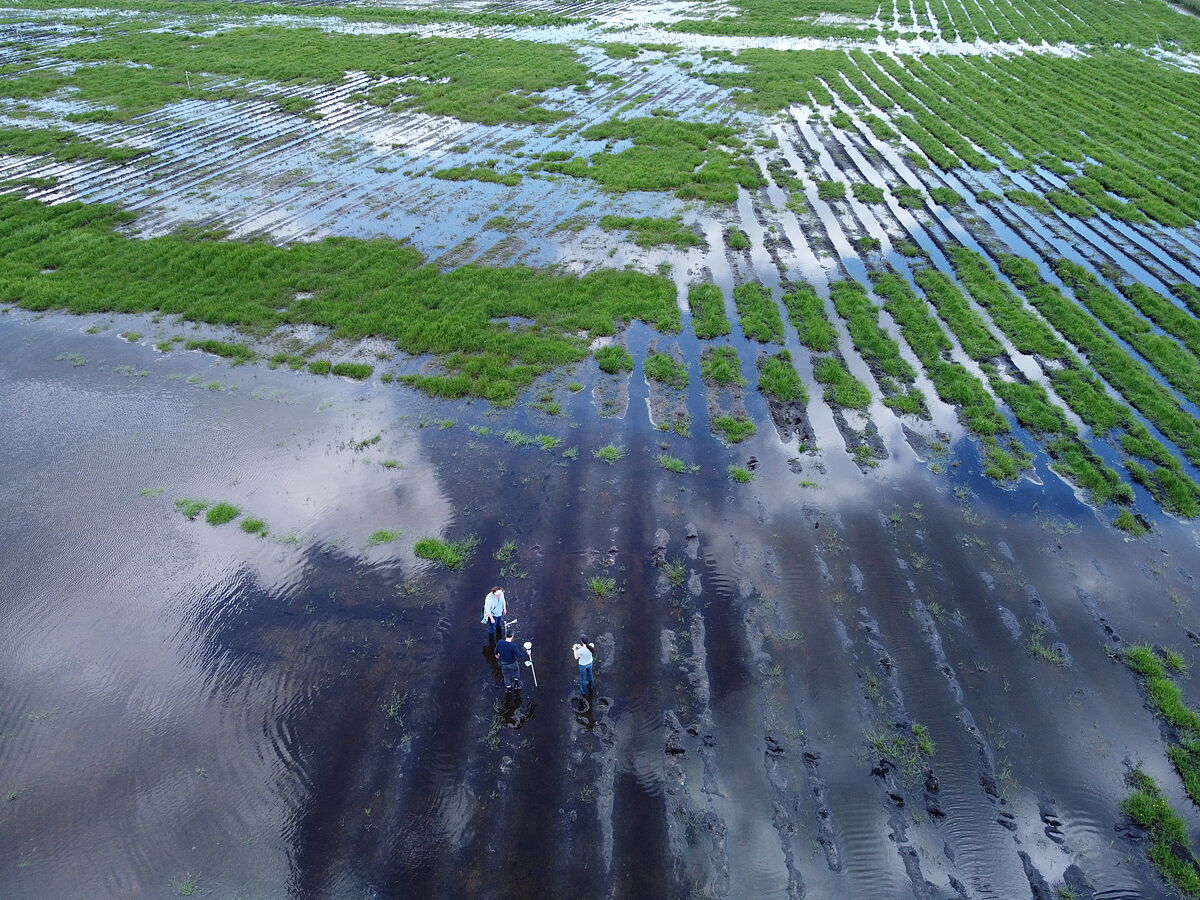
The drainage of fen peatlands has undesirable effects, particularly increased CO2 emissions and degradation of the peat body, resulting in land subsidence. Rewetting these areas contributes to climate and soil protection by reducing CO2 emissions and stopping soil degradation. However, rewetting currently often means abandoning land use, making it economically unattractive. Paludiculture offers a way forward: growing suitable plants on rewetted peat soils allows these areas to be used profitably. Comprehensive knowledge of large-scale practical cultivation and profitable utilization pathways is still lacking.
This is where the Paludi-PRIMA project comes in: establishing large-scale practical cultivation provides information on labour requirements and costs for future users. Biomass research focuses on quality, not just quantity. The native species under investigation are common reed (Phragmites australis) and cattails (Typha angustifolia, Typha latifolia).
The Paludi-PRIMA project is a joint project of the University of Greifswald and the State Research Institute for Agriculture and Fisheries Mecklenburg-Vorpommern (LFA). The University of Greifswald is represented by the working groups Peatland Studies and Palaeoecology (Prof. Joosten), General and Special Botany (Prof. Schnittler), Experimental Plant Ecology (Prof. Kreyling), and General Economics and Landscape Economics (Prof. Beckmann). This interdisciplinary team makes it possible to address a wide range of aspects of paludiculture:
These range from legal frameworks (the legal framework for implementing paludiculture) and economic aspects (gathering practical experience of large-scale cultivation, for example costs and labour requirements) to biomass quality (particularly the use of reed for thatching), genetics (genotyping reed and characterizing stands in Mecklenburg-Vorpommern), and management (the effects of water levels and nutrients on reed and cattails).
Within the PRIMA project, we investigate the effects of different management regimes. We use a mesocosm experiment in which five different reed clones from Mecklenburg-Vorpommern, together with broadleaf and narrowleaf cattail, are grown at different water levels and fertilization levels. Plant growth and vitality are examined to derive management strategies and recommend suitable species or clones for different conditions. The biomass produced is used for quality analyses. Within the large-scale field trial, the effects of two nutrient levels and different harvest dates on the growth and nutrient retention of one reed clone are investigated.
Additional information
The project is funded by the Agency for Renewable Resources (FNR), the project management agency of the Federal Ministry of Food and Agriculture (BMEL).