Peatland Climate Protection on the Baltic Sea Coast
The ANK‑funded joint project "Peatland Climate Protection on the Baltic Sea Coast" aims to rewet approximately 850 ha of coastal peatland areas in Mecklenburg-Vorpommern, Germany, between 2024 and 2034.
As part of the project, the University of Greifswald monitors key greenhouse gases - carbon dioxide, methane, and nitrous oxide - at selected sites and examines the observed emission dynamics.
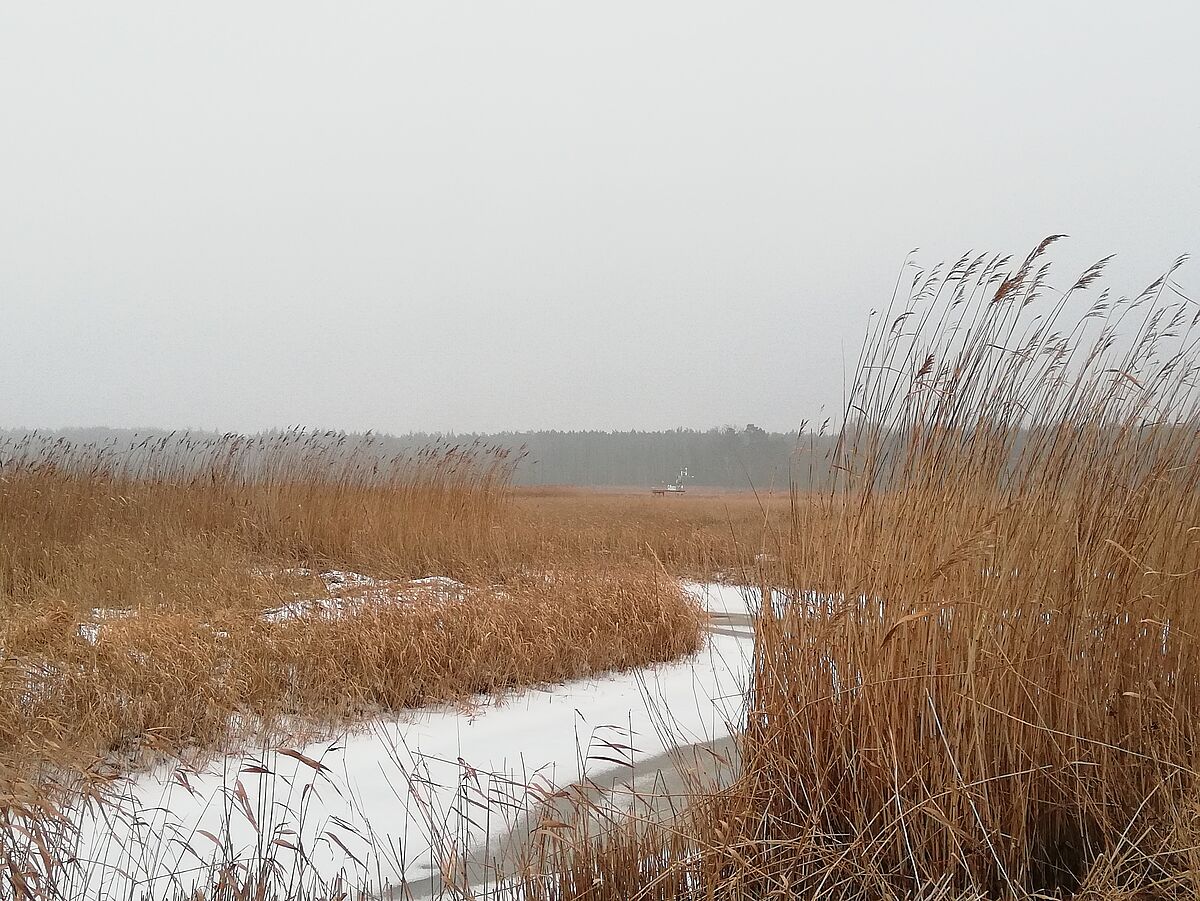
The originally about 40,000 ha of coastal peatlands in this region are today almost entirely embanked, drained, and used for agriculture, leading to substantial greenhouse gas emissions. Rewetting slows mineralisation processes and restores the natural carbon storage function of these ecosystems. The planned restoration measures are expected to reduce climate-relevant emissions by approximately 15,000 to 25,000 t CO2 equivalents per year. In addition, the project seeks to generate synergies between climate protection, flood control, nutrient retention, and biodiversity.
While the Leibniz Institute for Ostseeforschung Warnemünde investigates potential nutrient shifts into the Baltic Sea, and the Naturschutzstiftung Deutsche Ostsee addresses the practical implementation of polder de-embankment and rewetting, the Moor Research Working Group at the University of Greifswald - a partner in the Greifswald Moor Centre - conducts the scientific monitoring research on the climate impacts of these renaturation measures. Greenhouse gas fluxes at selected reference sites are measured before, during, and after rewetting using the eddy covariance method. Furthermore, underlying biogeochemical and physical processes and interactions are investigated. The aim is to quantify and explain the achieved emission reductions scientifically and to derive recommendations for future peatland restoration projects.
Project Objectives
- Investigation of greenhouse gas exchange between the ecosystem and the atmosphere before, during, and after rewetting (climate impact)
- Monitoring of seasonal and diurnal dynamics of methane (CH4) and carbon dioxide (CO2) emissions using the eddy covariance method, complemented by chamber measurements to assess nitrous oxide (N2O) dynamics
- Analysis of biogeochemical and physical processes and interactions that control the observed greenhouse gas emissions
- Investigation of the longterm development of carbon storage, sedimentation rates, and vegetation dynamics following rewetting
- Evaluation of site conditions and restoration strategies in terms of climate mitigation, and derivation of practical recommendations for the rewetting of drained coastal peatlands
Project partners and contacts:
Prof. Dr. Gerald Jurasinski, Dr. Carolin Waldemer, Jannis Raatz
Funding:
Bundesumweltministerium / BfN (Aktionsprogramm Natürlicher Klimaschutz ANK), additional funding by the Ministerium für Klimaschutz, Landwirtschaft, ländliche Räume und Umwelt Mecklenburg-Vorpommern (LM)
Links:
More climate protection through restored coastal wetlands – BfN
Peatland Climate Protection on the Baltic Sea Coast
Successful launch of the joint project – Baltic Sea Foundation
Project Website IOW