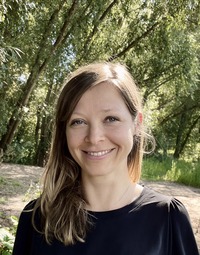
Dr. Carolin Waldemer
Areas of work
- Greenhouse gas emissions from drained coastal peatlands before, during, and after rewetting
- Eddy covariance measurements
- Biogeochemical and physical processes and emission dynamics of greenhouse gases in aquatic and semi‑aquatic systems
2025 – 2033
Postdoctoral researcher, University of Greifswald, Botany and Landscape Ecology / Peatland Science group, project Peatland Climate Protection on the Baltic Sea Coast
2019 – 2024
Doctoral researcher, Helmholtz Centre for Environmental Research - UFZ, Magdeburg, Department of Lake Research / Lake Microbiology Working Group, project Gas bubbles in freshwater ecosystems, focus: Greenhouse gas emissions from aquaculture systems
2019 – 2019
Research assistant at the University of Bayreuth, Department of Soil Ecology
2016 – 2018
Project Engineer, CDM Smith Consult GmbH
2012 – 2015
M.Sc. Geoecology – Environmental Science, University of Bayreuth
2009 – 2012
B.Sc. Geoecology – Environmental Science, University of Bayreuth
ongoing projects
- Peatland Climate Protection on the Baltic Sea Coast – ANK-funded collaborative project with the IOW and the Baltic Sea Foundation (2024–2034). The project accompanies the rewetting of coastal peatlands in Mecklenburg‑Western Pomerania and investigates their climate impact and underlying biogeochemical interactions. Eddy covariance measurements are used to quantify greenhouse gas fluxes.
Previous Projects
- Gas bubbles in freshwater ecosystems: origin, fate, and bubble-mediated transport – DFG-funded project in cooperation with Rheinland‑Palatinate Technical University Kaiserslautern‑Landau (2019–2024). The study investigated the formation, composition, and relevance of gas bubbles in aquatic environments, focusing on the biogeochemical and physical processes that control the release of greenhouse gas from freshwater systems.
Journal articles (peer-reviewed)
Lechtenfeld, O., Kaesler, J.M., Waldemer, C., Gao, S., Herzsprung, P. (2024). Fourier-transform ion cyclotron resonance mass spectrometry (FT-ICR MS) data of water extracted sediments from a fish pond. Data Investigation Portal UFZ. DOI: 10.48758/ufz.15122.
Waldemer, C., Lechtenfeld, O. J., Gao, S., Koschorreck, M., Herzsprung, P. (2024). Anaerobic degradation of excess protein-rich fish feed drives CH4 ebullition in a freshwater aquaculture pond. Science of The Total Environment, 954, 176514. DOI: 10.1016/j.scitotenv.2024.176514.
Waldemer, C., Schwarz, M., Lorke, A., Boehrer, B., & Koschorreck, M. (2024). Bubble sizes inferred from bubble gas composition in a temperate freshwater fish pond. Inland Waters, 14(1-2), 1-14. DOI: 10.1080/20442041.2024.2327974.
Shikhani, M., Reinschke, L., Aurich, P., Waldemer, C., Koschorreck, M., & Boehrer, B. (2024). Composition of photosynthetic gas bubbles from submerged macrophytes. Water Resources Research, 60(1), e2022WR034010. DOI: 10.1029/2022WR034010.
Waldemer, C., & Koschorreck, M. (2023). Spatial and temporal variability of greenhouse gas ebullition from temperate freshwater fish ponds. Aquaculture, 574, 739656. DOI: 10.1016/j.aquaculture.2023.739656.
Boehrer, B., Jordan, S., Leng, P., Waldemer, C., Schwenk, C., Hupfer, M., & Schultze, M. (2021). Gas pressure dynamics in small and mid-size lakes. Water, 13(13), 1824. DOI: 10.3390/w13131824.
Agethen, S., Sander, M., Waldemer, C., & Knorr, K. (2018). Plant rhizosphere oxidation reduces methane production and emission in rewetted peatlands. Soil Biology and Biochemistry, 125, 125. DOI: 10.1016/j.soilbio.2018.07.006.
Agethen, S., Waldemer, C., & Knorr, K. (2015). Only low methane production and emission in degraded peat extraction sites after rewetting. EGU General Assembly Conference Abstracts (Vol. 17, p. 13286).